The Strange Order of Things by Antonio Damasio
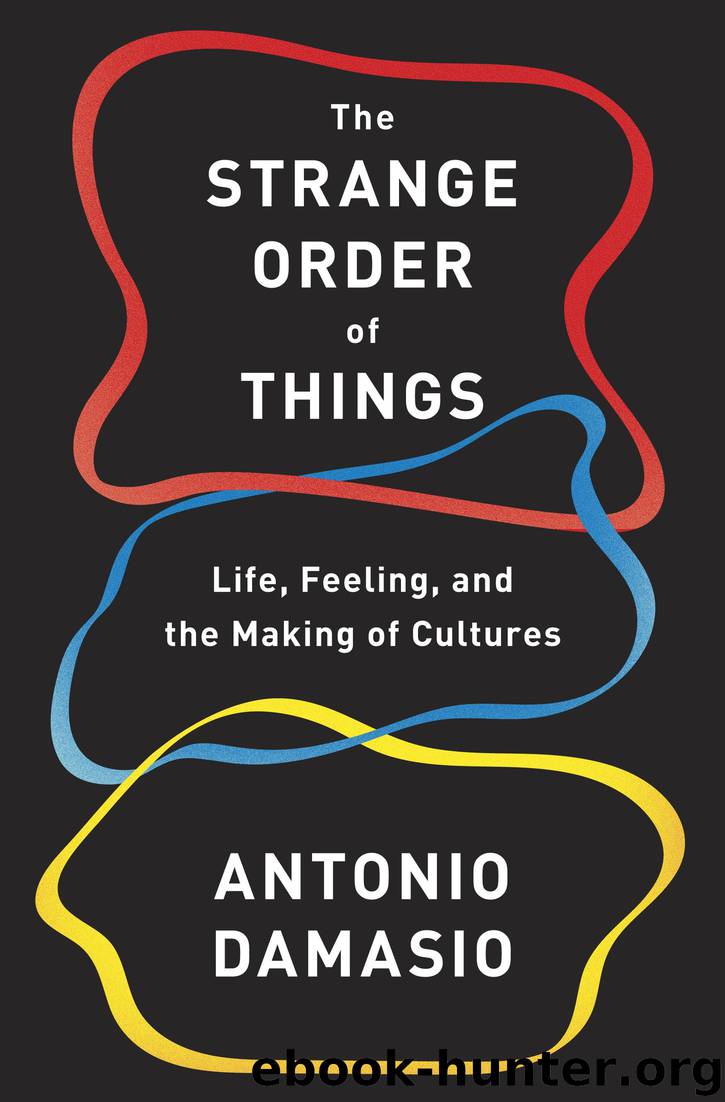
Author:Antonio Damasio
Language: eng
Format: epub, mobi
Publisher: Penguin Random House LLC
Published: 2018-02-06T05:00:00+00:00
1. Building a Perspective for Mental Images
When we “see,” the manifest visual contents in our minds appear to us from the perspective of our vision, specifically the approximate perspective of our eyes, as set in our heads. Precisely the same happens with the auditory images in your minds. They are formed in the perspective of your own ears, not the perspective of the ears of someone else located diagonally from you or, for that matter, from the perspective of your eyes. Likewise for tactile images: they have the exact perspective of your hand, or face, or wherever else in your body comes into direct contact with what is being touched. To be sure, one smells with one’s nose and tastes with one’s gustatory papillae. These facts are critical to understanding subjectivity, as we will see in a moment.
One of the main contributors to the building of subjectivity is the operation of the sensory portals within which we find the organs responsible for generating images of the outside world. The early stages of any sensory perception depend on a sensory portal. The eyes and the related machinery are a prime example: the eye sockets occupy a specific and delimited region within the body, within the head, even within the face. They have specific GPS coordinates within the three-dimensional maps of our bodies, the body phantom defined by our musculoskeletal frames. The process of seeing is far more complex than projecting light patterns onto the retina. “High end” vision begins in the retinas and continues over several stages of signal transmission and processing on to the cerebral cortices dedicated to vision. But in order to see, one first needs to look. Looking consists of many acts, and those acts are discharged by a complicated set of devices in and around the eyes, not by the retinas or visual cortices. Each eye has a shutter, a diaphragm, much like those of a camera, that control the amount of light admitted to the retina. There is also a lens, again like that of a camera. It can be automatically adjusted to bring objects into focus, our very original autofocus feature. Last, the two eyes move in varied directions, in a conjugated manner, up, down, left, and right, allowing us to survey and visually capture the universe all around, not just the universe in front of us, without having to move our heads or bodies. All of these devices are continuously sensed by our somatosensory system and produce the corresponding somatosensory images. At the very same time that we construct a visual image, our brain is also imaging the slew of movements executed by these intricate devices. In the most self-referential manner possible, they inform the mind, by means of images, of what the brain and body are in the process of doing, and they “locate” those activities within the body phantom. The body phantom images are subtle, part of the spectator side of the show. They are not as vivid as those that we describe in the consciousness show.
Download
The Strange Order of Things by Antonio Damasio.mobi
This site does not store any files on its server. We only index and link to content provided by other sites. Please contact the content providers to delete copyright contents if any and email us, we'll remove relevant links or contents immediately.
Sapiens: A Brief History of Humankind by Yuval Noah Harari(14458)
The Tidewater Tales by John Barth(12704)
Mastermind: How to Think Like Sherlock Holmes by Maria Konnikova(7429)
The Thirst by Nesbo Jo(7002)
Do No Harm Stories of Life, Death and Brain Surgery by Henry Marsh(6976)
Why We Sleep: Unlocking the Power of Sleep and Dreams by Matthew Walker(6783)
Life 3.0: Being Human in the Age of Artificial Intelligence by Tegmark Max(5617)
Sapiens by Yuval Noah Harari(5409)
The Body: A Guide for Occupants by Bill Bryson(5176)
The Longevity Diet by Valter Longo(5100)
The Rules Do Not Apply by Ariel Levy(5021)
The Immortal Life of Henrietta Lacks by Rebecca Skloot(4639)
Animal Frequency by Melissa Alvarez(4510)
Why We Sleep by Matthew Walker(4482)
The Hacking of the American Mind by Robert H. Lustig(4424)
Yoga Anatomy by Kaminoff Leslie(4405)
All Creatures Great and Small by James Herriot(4357)
Double Down (Diary of a Wimpy Kid Book 11) by Jeff Kinney(4332)
Embedded Programming with Modern C++ Cookbook by Igor Viarheichyk(4221)
